



Copyright © 2025 Shenyang Dasan Pharmaceutical Technology Co., Ltd.

 Posting Date:2022-09-02
 Views: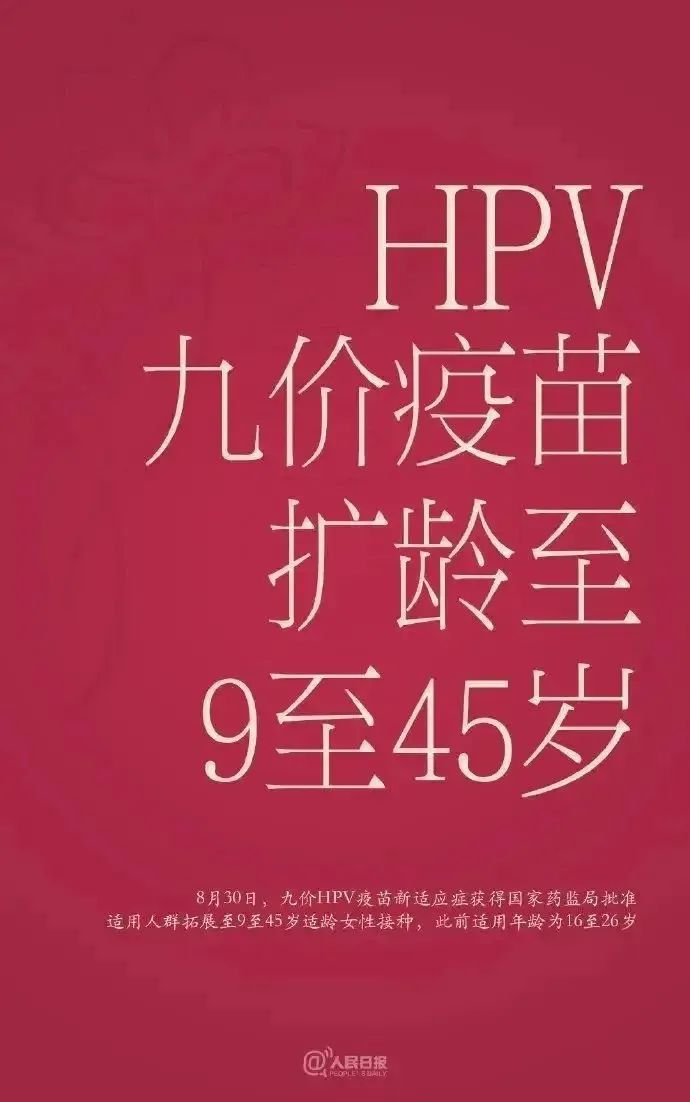
On the evening of August 30th, the "Merck Sharp & Dohme China" WeChat public account announced that a new indication for its 9-valent human papillomavirus vaccine (Saccharomyces cerevisiae) (hereinafter referred to as "9-valent HPV vaccine") has been approved by China's National Medical Products Administration. This approval signifies that the applicable population for Merck's 9-valent HPV vaccine in China has been expanded to women aged 9 to 45 years. Subsequently, the topic "HPV 9-valent vaccine expands age range to 9-45 years" quickly became the top trending search on Weibo.
The vaccine hasn't changed, so why has the age range expanded from 16-26 to 9-45?
According to the official website of the National Medical Products Administration, on April 28, 2018, the NMPA conditionally approved the above-mentioned 9-valent HPV vaccine for marketing, applicable to women aged 16-26. Why has the same vaccine been able to expand its age range from 16-26 to 9-45 years within just a few years?
"The approval of a vaccine's applicable age in China requires rigorous research data support," Bi Hui, Chief Physician in the Department of Obstetrics and Gynecology at Peking University First Hospital, told a reporter from China National Radio's Famous Doctors program. "Previously, clinical research for the 9-valent HPV vaccine had not been completed in China. However, in 2018, the World Health Organization set a goal for the global elimination of cervical cancer. Based on vaccine accessibility, it recommended the clinical application of three types of HPV vaccines. At that time, there was also significant demand from the industry for the 9-valent HPV vaccine. Consequently, the NMPA conditionally approved its marketing based on data from East Asian populations."
In response, an official document on the NMPA website clearly stated that the 9-valent HPV vaccine was approved using overseas clinical data directly for registration in China, treating it as a clinically urgently needed drug. The rationale for initially approving it for women aged 16-26 was based on three aspects:
1. The pivotal clinical trial supporting the marketing approval of the 9-valent HPV vaccine involved subjects aged 16-26. The NMPA's review and analysis of global registration clinical data and East Asian populations both showed the same protective efficacy, indicating that the benefits outweighed the risks.
2. An immunogenicity bridging trial was used for pediatric subjects aged 9-15, but clinical study data for this trial in East Asian populations was limited.
3. Women over 26 have a potentially higher likelihood of HPV exposure, and at that time, there was no evidence of the vaccine's protective effect for this age group after exposure.
Bi Hui explained: "Now, with clinical research data from China for the 9-valent HPV vaccine, it has been found that the immunogenicity in women aged 9-15 and 27-45 is comparable to that in the 16-26 age group. This means they have the same protective effect. Therefore, the applicable age can be expanded to 9-45."
She pointed out that vaccines are special drugs, with safety and efficacy as their two fundamental pillars. It is precisely based on these two considerations that this change in age indication occurred.
Regardless of the valency, timely vaccination is key
Currently, there are three types of HPV vaccines available globally: bivalent, quadrivalent, and 9-valent. The "valency" represents the number of virus subtypes the vaccine can prevent. Because the 9-valent HPV vaccine is the highest-valency vaccine available on the market for protection against HPV, it is highly sought after, often leading to shortages.
"Although getting the 9-valent HPV vaccine can provide higher protection, don't become overly fixated on 'higher valency.' Early vaccination and early protection are what truly matter," Bi Hui explained. There are 5 types of HPV vaccines across 3 categories in China. According to NMPA documents, international research data shows that over 70% of cervical cancers are caused by HPV types 16 and 18. Domestic research indicates that over 84.5% of cervical cancers are caused by these two types. Currently, the bivalent and quadrivalent vaccines available in China can prevent 84.5% of cervical cancer risk, while the 9-valent vaccine can prevent 92.1% of cervical cancers. Recently, a study by 17 research teams, including Professor Zhao Fanghui from the National Cancer Center/Cancer Hospital, Chinese Academy of Medical Sciences, and Professor Wu Ting from Xiamen University, published in the top international academic journal *The Lancet-Infectious Diseases*, showed that China's first domestically produced bivalent HPV vaccine provides up to 100% protection against HPV16- and HPV18-related precancerous lesions in women aged 18-45, demonstrating good immunogenicity persistence and high safety. It can be said that the protection offered by the bivalent and quadrivalent vaccines is already "sufficient."
Regular screening is still necessary after vaccination
"Getting the HPV vaccine is not a one-time solution," Bi Hui noted. Currently available HPV vaccines do not cover all high-risk genotypes, and their protective effect is weaker for those already infected. Furthermore, some older individuals fall outside the applicable age range for the vaccines. Therefore, while HPV vaccination is an important component of primary prevention for cervical cancer, it does not replace the need for regular cervical cancer screening.
"Even if you have received the HPV vaccine, you still need regular screening." It takes 8-10 years from HPV infection to the development of cervical cancer. Bi Hui advised that during this period, early detection of lesions caused by HPV infection, or early diagnosis and appropriate treatment with long-term follow-up, can best prevent the progression of lesions to cancer. Considering the risk of HPV infection and the risk of developing tumors, she recommends: women aged 25-29 undergo cytology screening every three years. After age 30, they can undergo HPV-based screening every five years, or cytology screening every three years.
 Previous:
 Back to List