



Copyright © 2025 Shenyang Dasan Pharmaceutical Technology Co., Ltd.

 Posting Date:2021-09-24
 Views:
 In a new study, researchers from Rush University Medical Center in the United States have made progress in the treatment of Parkinson's disease: a potential new therapy they developed has shown success in slowing disease progression in mice. The findings were published on September 10, 2021, in the journal Nature Communications under the title "Selective targeting of the TLR2/MyD88/NF-κB pathway reduces α-synuclein spreading in vitro and in vivo."
Specifically, the researchers found that two different peptides helped slow the spread of alpha-synuclein, a protein that appears in abnormal protein deposits in the brain known as Lewy bodies. Lewy bodies are a hallmark of Parkinson's disease. As the most common movement disorder, Parkinson's disease affects approximately 1.2 million people in the United States and Canada.
Lewy bodies are also associated with the development of Lewy body dementia and a rare neurological disorder known as multiple system atrophy (MSA).
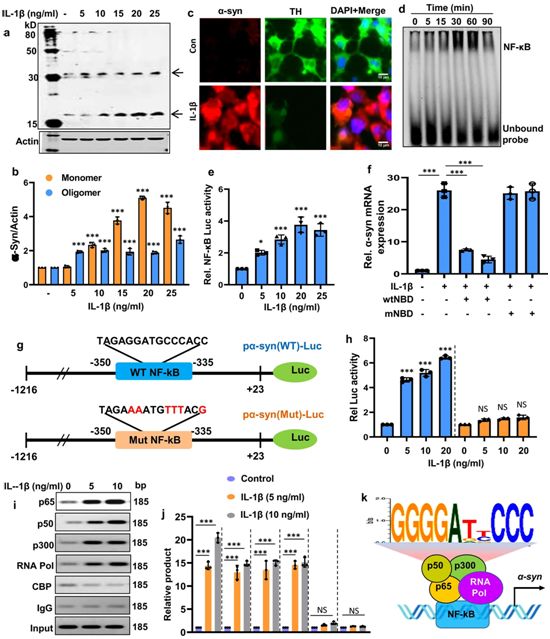
Activation of NF-κB increases α-synuclein expression in neurons. Image credit: Nature Communications, 2021, doi:10.1038/s41467-021-25767-1
 Previous:
 Back to List