



Copyright © 2025 Shenyang Dasan Pharmaceutical Technology Co., Ltd.

 Posting Date:2020-10-16
 Views:
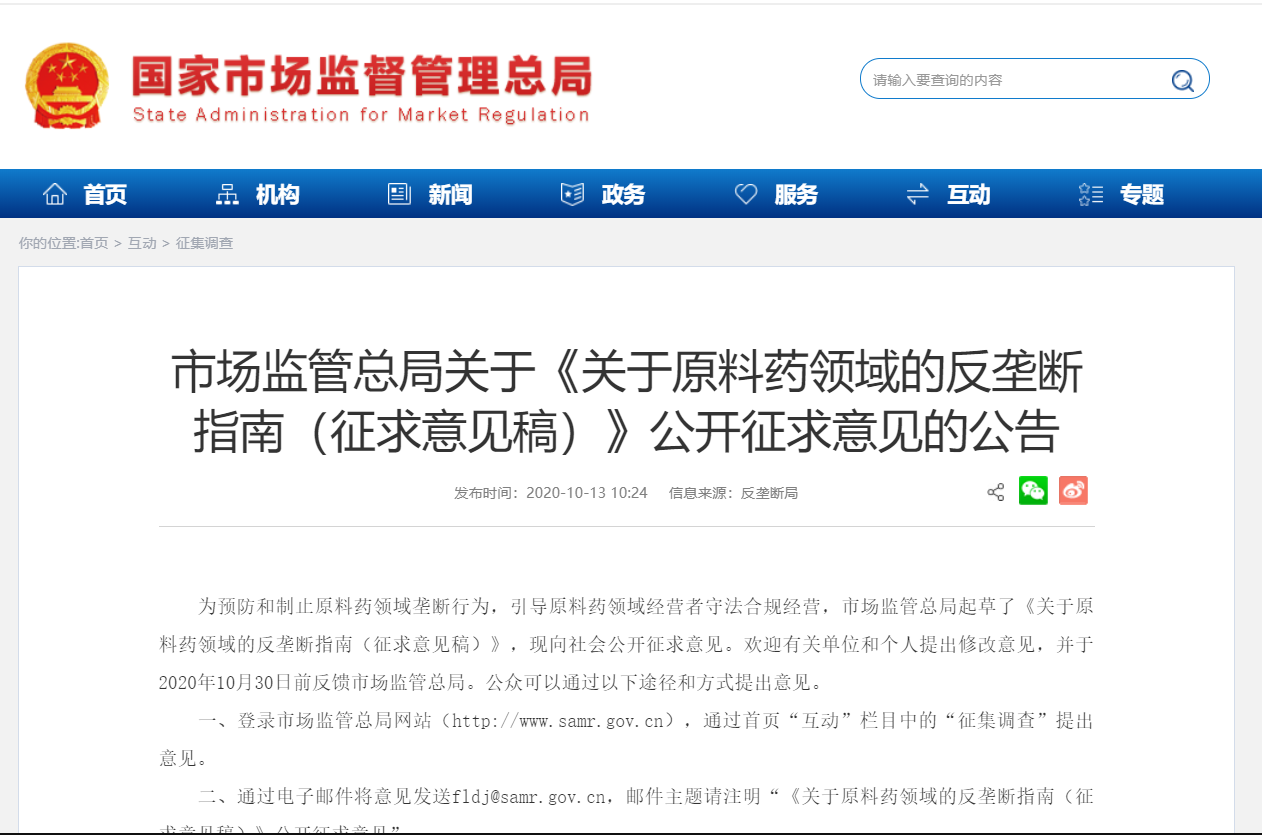
On October 13, the State Administration for Market Regulation (SAMR) issued the Anti-Monopoly Guidelines for the Active Pharmaceutical Ingredient (API) Sector (Draft for Comments), seeking public feedback. The aim is to prevent and prohibit monopolistic practices in the API sector and guide API market players toward compliance. However, opinions vary within the industry regarding the potential impact of these guidelines.
01. Another Step Forward in API Anti-Monopoly Efforts
Cracking down on API monopolies has become a key focus of the pharmaceutical industry rectification efforts. In 2017, the Guidelines on Price Conduct for Shortage Drugs and API Operators was introduced, becoming the first price monopoly guideline specifically for the pharmaceutical sector under China’s Anti-Monopoly Law. Policies such as the Opinions on Further Ensuring Supply and Price Stability of Shortage Drugs also explicitly emphasize strengthening enforcement against API monopolies and other violations.
The new guidelines further clarify and detail relevant scenarios. Previously, monopolistic practices in China’s API sector took various forms, including exclusive distribution, rebate agreements, supply refusals, etc. The abuse of market dominance often led to sharp price hikes or supply shortages of commonly used drugs.
Relevant data shows that among 1,500 APIs used in finished drugs in China, 50 are produced by only one approved manufacturer, 44 by two, 40 by three, and 10% by a handful of producers. API production is concentrated in the hands of a few companies.
To address this, the Guidelines state that API operators must comply with the relevant provisions of the Anti-Monopoly Law and refrain from reaching or implementing horizontal monopoly agreements with competitors.
For API manufacturers, the Guidelines advise against reaching agreements with competitors on joint production, procurement, sales, or bidding that cover production volume, sales volume, pricing, or customers. They should also avoid sharing sensitive information such as sales prices, output, and production plans through third parties (e.g., distributors or downstream drug manufacturers).
For API distributors, the Guidelines advise against reaching horizontal monopoly agreements with competitors regarding procurement volume, customers, sales volume, pricing, etc. They should also avoid disclosing sensitive information such as competitors’ sales prices, output, or production plans to API manufacturers.
The Guidelines also outline specific scenarios of vertical monopoly, such as API manufacturers imposing resale prices on downstream companies through contractual terms, or restricting profits, discounts, and rebates, enforcing price restrictions by revoking incentives or refusing supplies. It also notes that when determining vertical monopolies in the API sector, considerations may be given to relevant drug related review and approval regulations.
Furthermore, API manufacturers or distributors with dominant market positions may abuse such dominance through practices like unfair high pricing, refusal to deal, restricted transactions, tying, unreasonable trading conditions, differential treatment, or collective abuse. The determination of such abuses is governed by Chapter III of the Anti-Monopoly Law.
02. Can Stricter and Heavier Punishments Solve the Root Problem?
Beyond clearly defining monopolistic practices, the Guidelines also propose imposing heavier penalties on API monopolies. Given the frequent occurrence of such practices and the high level of awareness among operators, anti-monopoly enforcement agencies will impose stricter and heavier penalties on API operators who knowingly violate the Anti-Monopoly Law and deliberately evade anti-monopoly investigations.
Although cracking down on API monopolies has become a key focus, and several policy documents have been issued since 2017, cases of API companies being penalized for monopolistic practices under strict supervision remain common. Authorities have repeatedly issued fines for such cases.
On February 10, 2017, the State Administration for Industry and Commerce (SAIC) fined Wuhan Xinxing Jingying Pharmaceutical Co., Ltd. RMB 2.2 million for monopolizing the methyl salicylate API market. On February 13, 2017, the National Development and Reform Commission (NDRC) announced a penalty against Shandong Weifang Longshunhe Pharmaceutical Co., Ltd. for violently obstructing an anti-monopoly investigation, marking the first such penalty for obstruction. These fines once again brought API monopolies to public attention.
On July 31, 2017, the NDRC penalized Zhejiang Xinsaike Pharmaceutical Co., Ltd. and Tianjin Handewei Pharmaceutical Co., Ltd. for abusing their dominant market position by selling isoniazid API at unfairly high prices and refusing to deal without justifiable reasons. The two companies were fined a total of RMB 443,900.
However, such outcomes have also sparked controversy. Taking the methyl salicylate API case as an example, the monopolist reportedly acquired the entire output of manufacturers by offering attractive prices, dominating the national market. Media estimates suggested the monopolist, Shuntong Pharmaceutical, reaped nearly RMB 100 million in profits, while the official fine was only several million yuan.
In response, the NDRC issued the Guidelines on Price Conduct for Shortage Drugs and API Operators in November 2017, clarifying the link between shortage drugs and APIs and setting clearer red lines for price monopolies. Since then, enforcement against API monopolies has intensified, with individual fines escalating from tens of thousands to tens of millions of yuan.
On April 14 this year, the SAMR imposed penalties on three API distributors—Shandong Kanghui Pharmaceutical Co., Ltd., Weifang Puyunhui Pharmaceutical Co., Ltd., and Weifang Taishen Pharmaceutical Co., Ltd.—for abusing their dominant market position in the calcium gluconate API sector. The total fine amounted to RMB 325.5 million, the largest ever in an anti-monopoly case in the API sector since the enforcement of the Anti-Monopoly Law.
According to the SAMR’s penalty decision, these three companies controlled the domestic market for injectable calcium gluconate API from August 2015 to December 2017 through exclusive distribution, large-scale purchases, and requesting manufacturers not to sell to others.
The APIs produced by these manufacturers represent the main source of calcium gluconate APIs in China. With distribution channels controlled by these companies, downstream manufacturers had no room for negotiation and were forced to accept price increases. Although registered as independent legal entities, all three distributors were controlled by Kanghui Pharmaceutical.
While the release of the Guidelines signals continued focus on API monopolies, industry observers remain skeptical. Questions persist about whether regulators will proactively enforce the rules or rely on whistleblowing, and whether companies profiting from such practices will truly change their behavior. Some industry insiders have called for not only stronger supervision but also lower market entry barriers for APIs and expanded supply channels to fundamentally address the issue.
 Previous:
 Back to List