



Copyright © 2025 Shenyang Dasan Pharmaceutical Technology Co., Ltd.

 Posting Date:2024-05-28
 Views:
 In our daily lives, even simple pharmaceutical packaging can sometimes raise questions. Why does a blister pack sometimes have an intentionally empty space instead of being neatly filled with tablets? What are the reasons behind these phenomena? Today, let's uncover the secrets behind six mysterious features of blister pack packaging.
1. Why is there always one tablet missing from the blister pack?
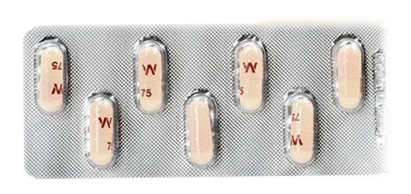
Have you noticed that many blister packs contain 7 or 14 tablets? This is because such quantities typically align with a weekly treatment course, helping to avoid medication waste. However, sometimes a blister pack intentionally leaves an empty space. This is actually for manufacturing convenience. Pharmaceutical companies may produce different package sizes simultaneously, using standard molds and production lines. By adjusting the arrangement of tablets, they can accommodate multiple specifications, thereby reducing costs.
2. Why are small tablets sometimes packaged in large blisters?
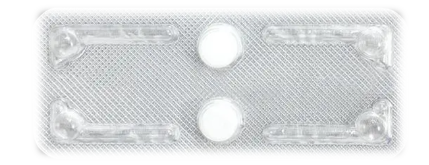
Sometimes a blister pack contains only a single tablet, yet the packaging is quite large. This is because, for certain low-frequency medications, although the required quantity per dose is small, the packaging still needs to maintain a certain size to prevent issues like loss or accidental ingestion. Additionally, larger packaging provides more space for printing drug information on the blister card.
3. What is the purpose of the "ridges" on the blister pack?
Sometimes you'll notice raised "ridges" in the middle, on the sides, or even around the entire perimeter of the blister pack. These structures are called reinforcing ribs. Their function is to prevent the blister pack from curling during the heat-sealing process, ensuring it can be smoothly inserted into the carton and preventing production line blockages.

4. Why are the "cavities" for some tablets so large?
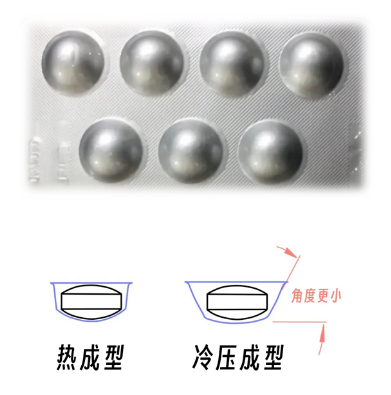
Some tablets are enclosed in silver, opaque blisters that appear significantly larger than the tablet itself. This is because the silver blisters are made from a composite material containing an aluminum foil layer, which provides better protection against moisture and light, preserving the drug's active ingredients. Additionally, these silver blisters are formed using a cold-forming process, which results in shallower cavity walls, requiring more surrounding space to accommodate the tablet.
5. What's the secret behind the large silver cover?
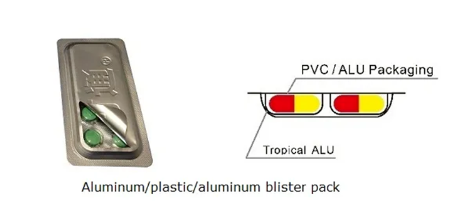
Some blister packs are entirely covered with a large silver cover. This design also aims to enhance light protection, moisture resistance, and oxygen barrier properties. Compared to silver blisters made using cold-forming, adding a cover to a standard plastic blister pack is a more cost-effective production method.
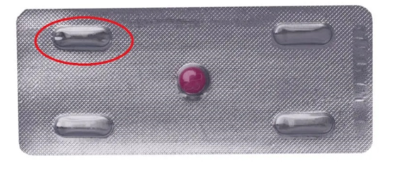
6. Are empty blisters without tablets a manufacturing defect?
Sometimes there are small empty blisters on a pack. This is not a manufacturing error but an intentional design. When the pack contains fewer tablets, adding empty blisters can make the packaging more stable during transport on the production line, prevent the pack from curling, or protect the drug when the package is compressed. The empty blisters are shaped differently from those containing medication to prevent user confusion.
By understanding these secrets behind blister pack packaging, we can better appreciate the design intent and scientific principles involved. Furthermore, these designs reflect the pharmaceutical manufacturer's efforts to balance convenience with safety.
 Previous:
 Back to List